
In cases where the weak automotive parts break during transportation, the cause is hardly ever attributed to rough handling. The damage in most instances is caused by the fact that the packaging absorbs the energy and transmits it improperly not due to thinness of the box walls and weakness of the material.
Delicate auto parts must be packaged to be able to handle shock, vibration, and variation in handling. This can be simply achieved by adding some heavier materials or bigger boxes that might appear as secure, and they create new failure modes. Flimsy components break when the packaging takes the force wrongly- not because boxes are too narrow.

What Qualifies as Fragile Automotive Components
Conclusion first: Fragility in automotive parts is characterized by the sensitivity to energy and motion, rather than size or weight.
Sensors and electronic modules
The components of the supply chain that are the most sensitive include automotive sensors, ECUs, camera units, radar modules, and control boards. They are sensitive in their internal circuitry, solder joints, and other calibration sensitive components that may be destroyed by comparatively low amounts of shock or vibration.
Precision-machined parts
Optical components like fuel injection elements, assemblies of valves or precise housings might seem hardy, yet with tight tolerances, can be easily susceptible to fissile-fissile boundary micro-deformation, or surface wear or misalignment during delivery.
Components sensitive to vibration or misalignment
Certain sections will not fail directly, but due to the vibration during prolonged operations, which leads to fatigue, loosening of the part, or internal displacement. These elements are usually mistaken to be non-brittle up to the point of breakdown in the field that exposes the fragility of the packaging.
The fragility of package needs must be determined based on the necessary packaging requirements per component type and not on the appearance or visual opinions and weight of the parts.
The Real Risks Fragile Automotive Components Face During Transport
Conclusion first: the damage to fragile parts is not usually catastrophic, but accumulative.
Shock and drop impact
High-energy impulses are added during drops during manual handling, pallet changes, or during sorting of the parcels. The packaging should not just cushion the outer shell but it should restrict maximum acceleration onto the part.
Vibration and resonance
Sustained vibration is caused by long-distance road, sea or air transportation. Bearing in mind that packaging enables parts to vibrate to certain frequencies, the damage may be done even without an observed impact.
Handling variability across logistics stages
Delicate components travel across various locations, such as factory floors, consolidation centers, a distribution center, and the last-mile delivery. The variability of each stage is one of the most underrated risks since each stage brings in new handling behaviors.
This is the reason why delicate automotive packaging should not be considered as a one-material choice, but as an element of a larger automotive packaging strategy of delicate elements. Many manufacturers address this through custom automotive packaging boxes engineered around real transport conditions rather than assumptions.
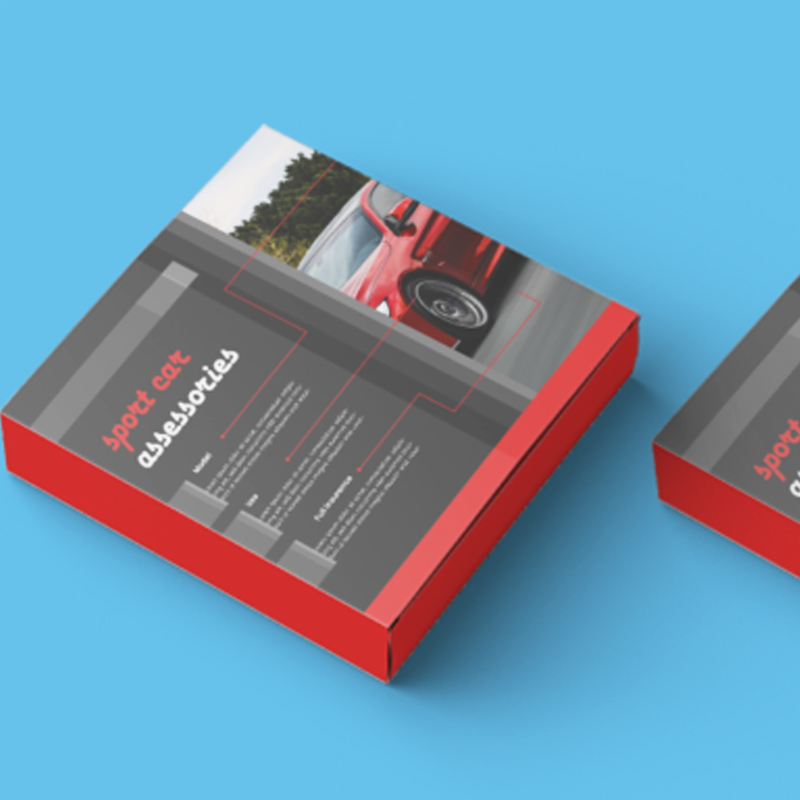
Packaging Structures That Work for Fragile Automotive Parts
Conclusion first: Structural design tends to be more important than material thickness.
Rigid boxes for controlled environments
Rigid packaging works well when supply chains are closed and predictable and there is standardization in handling as well as palletization. When these happen, rigidity assists in preservation of orientation and avoidance of stacking deformation.
Nevertheless, rigid boxes are not effective shock absorbents unless they are designed to provide internal systems.
Corrugated packaging with engineered inserts
Rigid forms can be defeated by corrugated forms in open distribution when properly designed. Board thickness is not important, but it is structure plus insert interaction.
Choosing between rigid and corrugated solutions requires understanding structural packaging choices for fragile components, structural packaging decision in relation to fragile parts particularly when transport routes and handling intensity values differ.
When structure matters more than material thickness
Uncontrolled overbuilt walls tend to pass the energy into the component. More important than merely adding material weight is structural load paths, internal clearances and deformation zones.
Insert and Cushioning Strategies for Fragile Components
Conclusion first: The effective inserts are in control of motion, prior to its absorption.
EVA vs EPE vs molded pulp (high-level)
- EVA offers accuracy in positioning and constrained movement hence suitable to parts that are sensitive to deviation.
- EPE has a good ability to absorb shocks, though it needs to be designed thoughtfully so as not to free-ride.
- Molded pulp has high support of structural separation and sustainability objectives but low vibration damping.
Selecting the right approach requires understanding insert design strategies for shock absorption the insert to absorb shocks concerning the actual failure modes of the part.
Suspension vs immobilization approaches
Suspension supports permit components to float in a package and minimize maximum shock. The immobilization systems provide components attached, such that no relative motion occurs. No one of these methods is universally better – both methods only work when they are in relation to the sensitivity profile of the part.
Avoiding over-constrained designs
High stiffness inserts may increase the transmission of vibration and may cause a stress concentration. Packing that seems to be safe can be dangerous when it inhibits natural energy release.
Testing and Validation for Fragile Automotive Packaging
Conclusion first: The number one cause of fragile-part damage is untested packaging assumptions.
Drop testing
Drop tests check the response of the packaging to realistic handling conditions. One should measure the acceleration on parts, rather than box deformation.
Vibration simulation
Vibration testing indicates resonance problems which cannot be noticed via the static analysis. Most delicate parts fail in long-periodic vibration as opposed to isolated impacts.
Iterative design improvements
Development of good packaging is a process. Adjusts to insert geometry, material selection and structural layout must be based on test results, not as pass/fail exercises.

Common Packaging Mistakes With Fragile Automotive Components
Conclusion first: A majority of errors arise when people do not understand risk as opposed to not acting on it.
Overpacking without understanding risk
Applying material without knowledge of the flow of energy usually raises costs without enhancing protection. This also makes it difficult to pack and ships heavy.
Ignoring vibration damage
A lot of the packaging designs only consider drops without taking into consideration the vibration aspect and this causes delayed failures which are more difficult to trace.
Designing packaging without transport context
The packaging that is developed without taking into consideration the logistics realities fails in a world that is subject to the realities of handling and transportation.
How to Design Packaging That Reduces Damage Rates
Conclusion first: Alignment not excess brings damage reduction.
Aligning packaging with real-world handling
Packaging needs to be based on the actual movement, stacking and transportation of the parts, rather than how the designers want the parts to be treated.
Early packaging involvement in product launch
The involvement of packaging engineers in the early product development process helps avoid compromises later in the development stage and minimize the risk at the down stream.
Cost considerations should always be evaluated through the lens of balancing protection and packaging cost, ensuring protection strategies remain sustainable at scale.
Conclusion — Protecting Fragile Components With Engineering Logic
Fragile automotive component packaging systems are not material stacks. Close attention to managing the flow of energy shock, vibration and movement through considered structural and insert design is an effective defensive.
When the engineering logic is used to make a decision in packaging and it is tested, the rate of damage is reduced without introducing the complexity unnecessarily.
Successful packaging of delicate automotive parts deals with energy, not impact only.