
When it comes to automotive packaging, the insert material is usually much more important than the outer box construction since inserts directly handle the internal forces such as compression and shear which cannot be handled by the box alone and thus the part will not be damaged during the handling process by motion or impact. Some failures in the automotive parts are not caused by the transit mishaps but are caused by poor designs of the inserts that can not reduce the vibration or positioning capabilities resulting to such problems as scratches on machined parts or misalignment of assemblies in ECUs. The outer box serves only as an enclosure where the insert serves as the main touch point with the part absorbing energy, and keeping everything stable, EVA has been used in precision fits with electronics, EPE in economical cushioning of middle-weight parts, and molded pulp in sustainable structural support of larger parts. Movement and energy, not only cushioning thickness, are governed by the right insert material.
Why Inserts Are Critical in Automotive Packaging
Inserts form the core defensive layer in automotive packaging, direct proportion to the external structure, the internal dynamics will be taken care of through inserts rather than the outer structure.
Movement control: In a standard supply chain, part flow undergoes a lateral movement during pallet stacking or inside the conveyor turns; parts such as EVA trays clamped to prevent contact during turning of parts, which is necessary to prevent contact damage in multi-part kits.
Shock and vibration: Automotive transit requires 5-20g drop or vibration in roads to 50Hz- damaging parts choose dissipating inserts, materials-mass parts- 1 unless cracks in metals occur and solder joints fail in electronics- choose correctly.
Part orientation: In assemblies such as wiring harnesses, kinking can be avoided by maintaining a straight part orientation, and alignment achieved by using cradles made of the molded pulp reduces assembly lines by 15-25 percent based on field experience in supplier audits.
EVA Inserts for Automotive Packaging
EVA is the best choice in high-precision, high-position components when tight tolerances and consistent energy absorption are needed but is not good in high-volume or heavy components because of cost and scalability constraints.
Mechanical properties: Ethylene-vinyl acetate (EVA) foam is used as closed cell materials, with such property as densities ranging between 30-200 kg/m 3, high-resilience, rebound rates reaching 90 and above, and waterproofing capabilities to avoid entry of moisture in damp warehouses. It can be molded to have custom cavities with tolerances below 0.5mm.
Common automotive uses: EVA has been used with electronic components such as sensors or control units whose specifications require it to absorb up to 50g without deforming, or in fragile painted components such as trim pieces which require a scratch protection in short-haul OEM purchasing.
The features Strengths Strengths: Excellent vibration damping (reducing amplitudes by 60-70%), clean appearance on unboxing; Weaknesses: More expensive (15-30% more than EPE), and poorer thermal conductivity above 80 C, where softening may occur in an unboxed enclosure;
EPE Inserts for Automotive Packaging
EPE can be used in components that require energy absorbing capability and some amount of allowable deformation like mid-weight mechanical components, but not in high precision electronics where compression set may lead to misalignment.
Cushioning behavior: Expanded polyethylene (EPE) is open-cell foam with a density of 15-45 kg/m 3, which offers progressive compression to absorb impacts by deforming – shock attenuation up to 30g – and weighs less than 50g per insert, as well as is waterproof.
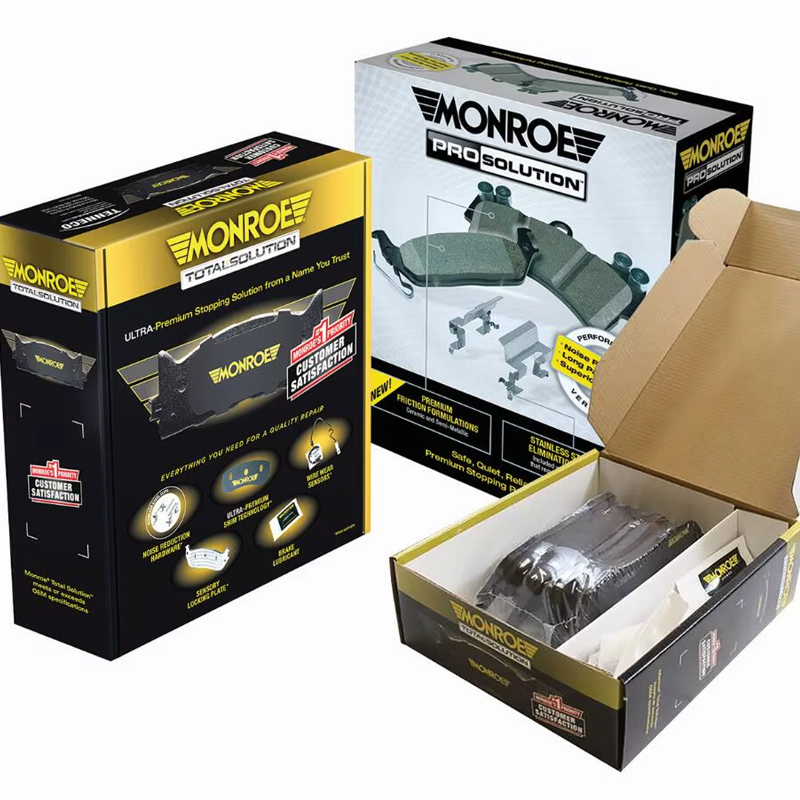
Typical uses EPE is used in aftermarket packaging of brake pads or hoses, to cushion vibration on truck freight, or when a shape is irregular such as a belt where flexibility is more suitable than rigid materials.
Typical misuse examples: Misuse may be seen when used on heavy components (>5kg) where permanent deformation results (compression set >20% after cycles), this is seen in high-precision applications where rebound variability results in shifts- causing 10-15% increased damage rates in test.
Molded Pulp Inserts for Automotive Packaging
Molded pulp is suitable where structural support and sustainability objectives are needed such as bulk metal components in eco-oriented chains, but not where vibration is an issue or moisture sensitivity is needed because of reduced strength.
Structural support vs cushioning: Molded pulp is made of recycled paper slurry and has compressive strengths of 100-200 psi at 0.5-2mm thick to provide nesting, yet little energy absorption (less than 10g shocks).
Sustainability benefits: It is 100% recyclable and biodegradable, cutting carbon footprint 30-50% compared to foams and has such certifications as FSC, which is compatible with automotive ESG requirements-initial investments are 2-3x than EPS and is made up by savings in compliance in the long run.
Limitations in vibration control: Pulp absorbs little vibration (damping less than 40 percent), which is dangerous in road transit; moisture uptake (10 percent weight gain) may compromise structures, not a good choice in electronics or wet exports, where failures are maximally 2030.
Comparing EVA, EPE, and Molded Pulp Inserts
EVA is more accurate in precision protection at higher rates, EPE is balanced in cushioning and affordability in general use, and molded pulp is more sustainable with less damping- pick depending on quantified risks, such as vibration spectra.
Protection performance EVA can withstand drop sizes of 50g + with less than 5 per cent of the energy transferred; EPE can withstand 30g with deformation; pulp can withstand bracket static loads of less than 10 g – EVA on ECUs, EPE on filters, pulp on brackets.
Dimensional stability: EVA will have less than 1 percent compression set; EPE 10-20 percent, pulp close to 0 percent but will be brittle EVA/EPE dynamic, pulp fixed.
Cost and MOQ: EVA, 0.50-1.50/unit, MOQ, 500+; EPE, 0.30-0.80, MOQ, 200; pulp, 0.20-0.60, MOQ, 1,000, EVA low-volume premium, others scale.
Environmental factors: Pulp has a highest rating on recyclability; there are petroleum based but recyclable derivatives of EVA/EPE, such as pulse in green chains, foams where performance is paramount.
Insert Selection Based on Automotive Part Type
The choices to be inserted should be compatible with the part vulnerabilities in automotive packaging as the EVA to electronics, EPE to mechanicals, and pulp to structurals- test integrations to verify.
Electronic elements: The dielectric characteristics and accuracy fits of EVA preserve PCBs in systems; improper usage of EPE in this case may lead to either statical discharge or drift, which provokes solder failures.
Machined components: EPE: conformity cushions gears or shafts to prevent scratches; pulp gives a structure to stack but does not provide damping – do not use EVA unless the cost is justified.
Massive or non-uniform components: The moulded shapes of pulp carry bumpers or frames without collapsing; EPE shapes itself to unusual shapes – EVA engages in overengineering unless it is essential to the required level of accuracy.
Common Insert Design Mistakes in Automotive Packaging
Frequently made mistakes during insert design: wrong choice of materials, which results in increased destruction or expenses always check with FEA or drop tests.
Over-constraining components: Flexible hoses are made of rigid EVA to create stress-inducing cracks instead of the natural flexing enabled by EPE—choose EPE.
No vibration damage: Pulp choice The poor damping that occurs when selecting pulp to road-transit electronics should not be ignored: fatigue will occur, switch to EVA/EPE when spectral shows >20Hz peaks.
Selecting material that has not been tested: The selection of EPE as a moisture-sensitive part results in degradation; test in environmental chambers- mistakes in this type of testing swell claims 15-25%.
How to Design Insert Systems That Actually Reduce Damage
To create effective designs of automotive packaging, it is necessary to go through the design in several iterations, match the materials with the transit data and reduce harm by 20-30 percent- begin with risk mapping.
Testing/validation: Simulate shock/vibration using ASTM D4169 protocols; design iterate using accelerometer data- vital to OEM zero-defect objectives.
Matching insert design with actual conditions in the transport: Study chain logs of G-forces; find EVA corresponding to the drops of airfreight, EPE to vibrations of the trucks-do not use generic specifications.
Strategies in packaging insert In car packaging packaging, the strategy that involves coordination with the outer structure provides synergy;, how packaging structure affects insert performance guides rigid vs corrugated pairings.
For comprehensive systems, consider automotive packaging solutions for auto parts that integrate inserts holistically.
For fragile parts, reference protection strategies for fragile automotive components to refine choices.
When budgeting, weigh cost trade-offs in insert material selection against performance.
Tailor to part types via insert selection based on part characteristics.
Conclusion — Inserts Define Packaging Performance
Inserts are the control layer that is used as the most important in automotive packaging and can deal with the risks that cannot be dealt with by the outer structures. Through choosing EVA, EPE, pulp based on its preciseness, flexibility, or sustainability that is proven in testing, suppliers reduce the number of failures. Part Survival depends on the inserts that help a part to endure the voyage- not on the box.